 Tally
A badge only a real card can hold.
A verified card is an NFT on NEAR that the trader holds. Its rules are built into the contract, so nobody has to take Tally's word.
What is a verified card?
A badge for a PnL card Tally found real.
It can only exist for a card the record on NEAR says is Real, and anyone can have it rechecked.
What it stores
- The card's fingerprint
- The NEAR account the trader chose to hold it
- The check it came from
- The money it holds
What the trader holds
Example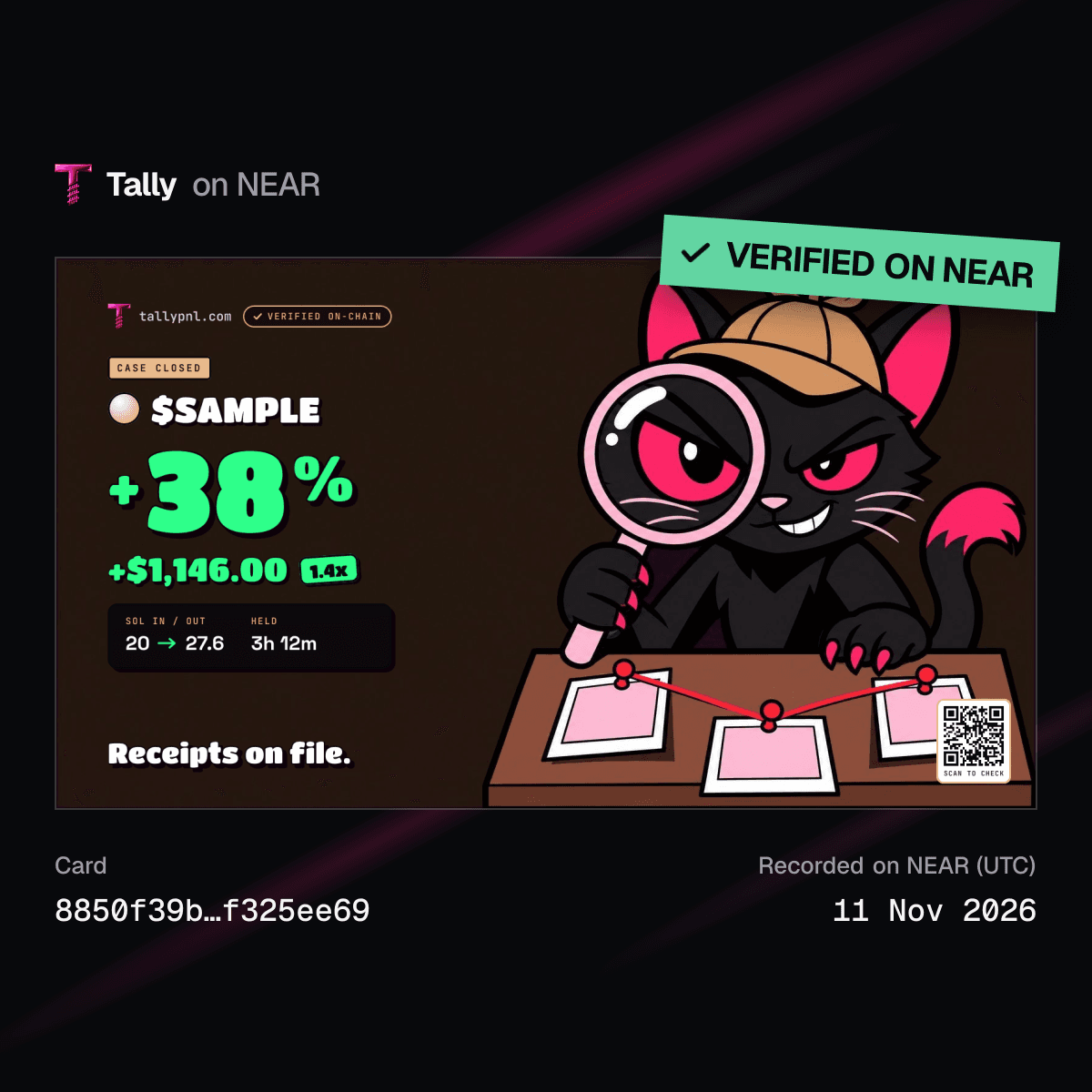
The trader's own Tally card with a stamp. Wallets and explorers show it for the NFT.
Three rules, enforced by the contract
Earned, never bought
It's only minted for a real card. The contract asks the record on NEAR itself.
Bound to the trader
It can't be sold or moved, so it can't be bought.
Removed if the verdict changes
Anyone can ask for a recheck. If the record no longer says Real, it burns.
How a card gets one
Tally checks the card
The verdict, Real, is written to NEAR.
Tally asks for the mint
The contract looks the card up on NEAR first.
The trader holds it
In the NEAR account they chose. Nobody else can take it.
A badge that holds money Live on testnet
When an AI agent pays to check a card, part of the fee goes into the card's badge. A faker has no badge and earns nothing.
No outside agent pays yet, so this is a working mechanism, not income to count on. Looking a card up stays free for everyone.
- The trader takes it out while the card is Real.
- A badge that burns loses what it held. Nobody gets that money, Tally included.
Technical restrictions
What the contract refuses, word for word
- Minting for a card found Fake or Unclear
- “Only a card the proof registry says is Real can be verified”
- Minting for a card Tally never checked
- “Tally hasn't checked this card, so it can't be verified”
- Anyone but Tally asking for a mint
- “Only Tally's attester can mint a verified card”
- Selling it or sending it to someone else
- “A verified card can't be transferred: it stays with the trader who earned it”
- Minting a second one for the same card
- “This card already has its verified card”
- Anyone but the holder taking out its money
- “Only the holder can withdraw what their verified card holds”
- Giving up a card that still holds money
- “Withdraw what this card holds before giving it up”
Mint, recheck and burn
mint can only be called by Tally's account, and the contract asks the registry before it mints. One card, one badge.
recheck can be called by anyone. If the registry's latest verdict is no longer Real, the badge is burned on the spot.
burn lets the holder give their own badge up, once they have taken out what it holds.
How it holds money
earn pays a badge. Anyone can call it, and the paid check sends each trader's share through it.
withdraw pays the holder, and the contract asks the registry first. It pays only while the verdict is still Real.
forfeited shows what burned badges held. That money stays locked: no function of the contract can move it.
NFT standards and views
A standard NEAR NFT (NEP-171) with metadata (NEP-177) and enumeration (NEP-181), so wallets and explorers can show it. The token's id is the card's fingerprint.
Free reads: nft_token, nft_tokens, nft_tokens_for_owner, nft_supply_for_owner, nft_total_supply and nft_metadata. Both transfer methods always refuse.
The contract has 30 unit tests. card.notpab.testnet · Its source on GitHub
The picture
Each token links to its picture at /badge/ followed by the fingerprint. This site draws it, and only while the contract still holds the badge and the registry still says Real.
The picture is drawn off-chain. The record on NEAR is what counts.